
Two-Post vs. Four-Post Lift: Which One Actually Fits Your Shop’s Workflow?
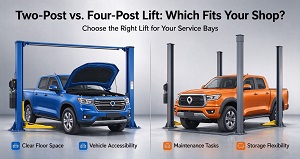
Every bay in your shop has a job to do. The lift you install determines how fast that job gets done, how safely your technicians work, and how many vehicles you can turn in a day. But the decision between a two-post and a four-post lift isn’t about which one is “better.” It’s about which one matches the work that actually rolls through your doors.
Here’s a direct breakdown of how each design performs under real shop conditions—so you can choose the lift that fits your workflow, not just your floor plan.
The Core Difference: How They Hold the Vehicle
A two-post lift engages the vehicle’s frame or lifting points with adjustable arms, suspending the car in the air with the wheels hanging free. This is the defining advantage for any shop that touches brakes, tires, or suspension.

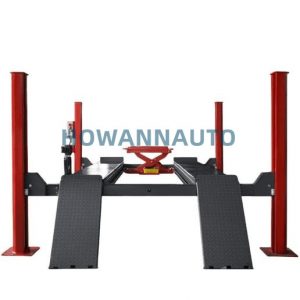
A four-post lift supports the vehicle by its tires on two runways. The car drives on, parks, and rises on a stable platform. The wheels stay planted—which is either a benefit or a limitation, depending on the ticket.
Two-Post Lifts: The Mechanical Shop Workhorse
If your bays see a steady mix of brake jobs, suspension repairs, tire rotations, and general undercarriage work, a two-post lift is likely the most efficient use of your floor space.
Where it wins:
-
Full wheel access. With the vehicle suspended by its frame, technicians can pull wheels, service hubs, and replace suspension components without fighting the lift structure.
-
Smaller footprint. Two-post lifts take up less horizontal space than four-post models, making them practical for shops with tighter bays or limited ceiling height.
-
Lower entry cost. Generally more affordable than comparable-capacity four-post lifts, both in purchase price and installation complexity.
Where it demands attention:
-
Precise positioning is non-negotiable. Technicians must correctly spot the vehicle’s lifting points every time. Rushed arm placement is a safety risk and a recipe for damaged underbody panels.
-
Floor requirements are stricter. Most two-post lifts require a reinforced concrete slab—often 30 cm or more—and proper anchoring. If your floor doesn’t meet spec, you’re looking at additional prep costs before installation begins.
-
Not ideal for long-term storage. Suspending a vehicle by its frame for extended periods puts stress on suspension components. If a car is waiting on parts for a week, a two-post lift isn’t the place to park it.
Best fit: General repair shops, brake and tire specialists, and any bay where the wheels come off regularly.
Four-Post Lifts: Stability, Speed, and Alignment
Four-post lifts shine in workflows where stability and drive-on convenience matter more than wheel-free access. They’re also the standard choice for alignment work and shops that need to store vehicles between jobs.
Where it wins:
-
Faster vehicle loading. Drive on, set the locks, and lift. No arm-spotting, no lifting-point guesswork. For high-volume quick-service work—oil changes, inspections, fluid services—this saves minutes per ticket.
-
Superior stability for heavy or awkward vehicles. Trucks, vans, and long-wheelbase vehicles sit more securely on four runways than on a two-post’s arms. Shops that regularly service heavier fleet vehicles often prefer the four-post design for this reason.
-
Alignment-ready. With turnplates and slip plates added to the runways, a four-post lift becomes a dedicated alignment station. The vehicle rests on its wheels at ride height—exactly what alignment geometry requires.
-
Storage capability. A four-post lift can hold a vehicle indefinitely without suspension stress. For shops that need to park a waiting car overnight or hold a project vehicle, that’s usable vertical space.
Where it demands attention:
-
Wheel service requires extra equipment. To pull wheels on a four-post lift, you’ll need a rolling bridge jack or sliding jack beam. That’s an added cost and an extra step per ticket.
-
Larger footprint. Four-post lifts occupy more floor area. If your bay is tight, measure carefully before committing.
-
Higher upfront investment. The additional structure and materials typically push four-post pricing above comparable two-post models.
Best fit: Alignment shops, quick-lube and inspection stations, fleet maintenance facilities, and shops that need vehicle storage capacity.
The Decision Framework: Match the Lift to the Ticket Mix
Before you compare spec sheets, answer these three questions about your actual workflow:
1. Do your technicians need the wheels off the vehicle to do their job?
If yes, lean two-post. A four-post can be adapted with a bridge jack, but it’s a workaround—not the native workflow. If your bays are built around brake and suspension revenue, a two-post keeps the path to completion short.
2. Is vehicle loading speed the bottleneck?
If you’re running high-volume quick service—oil changes, inspections, fluid flushes—the drive-on simplicity of a four-post reduces the per-vehicle setup time. Over a day of tickets, those minutes add up.
3. Do you need to store vehicles between jobs or overnight?
If your lot is full and your bays double as holding space, a four-post lift gives you a safe, suspension-friendly parking platform. A two-post cannot serve that role.
For shops that do both mechanical repair and alignment work, the answer isn’t always either/or. Many growing shops run a two-post as their primary mechanical bay and add a four-post alignment lift as a second station once volume justifies it.
Final Considerations Before You Buy
Whichever direction you lean, verify the fundamentals:
-
Concrete spec. Confirm slab thickness and strength with the lift manufacturer’s requirements. Two-post lifts typically demand more reinforcement; four-post models have different but still specific floor requirements.
-
Ceiling height. Both lift types need adequate overhead clearance, but two-post lifts often require more height for the overhead crossbar or shutoff bar.
-
Power supply. Check whether your shop runs 230V single-phase or 400V three-phase. Most full-size lifts are available in either configuration, but confirming before purchase avoids electrical surprises.
-
Certification. Look for lifts certified by a recognized safety body (such as the Automotive Lift Institute in North America or equivalent regional standards). Certification isn’t marketing—it’s the baseline for insurance and workplace safety compliance.
Ready to match a lift to your bay’s actual workflow? [Contact our team] for a consultation on capacity, floor requirements, and configuration options for your shop’s specific service mix.